
George Agnew Reid (1860-1947) was a Canadian artist, architect, educator and administrator influential in the early 20th century and instrumental in the formation of a number of important Canadian art institutions. Born in Wingham Ontario to a Scottish farm family, he studied architecture and book-keeping at his father’s insistence. In 1878 he moved to Toronto to study art. He was able to extend his art education under Thomas Eakins in Philadelphia, where he met the painter Mary Heister. In 1888 the couple travelled to Europe and studied at the Julian and Colorossi Academies, returning to Toronto in 1889. The house he designed and built in Wychwood Park was his home until the end of his life. In 1890, George Reid began reaching at the Central Ontario School of Art and Design. He eventually became principal and researched new theories of art education in the United States and Europe. Under his direction, the art school became independent of the Board of Education and moved into its own building, which he designed, in 1921. He also served as its first Principal. In 1892, George and Mary Reid built two cottages from his design at the artist colony in Onteora, New York. This led to the design of other summer homes and a small church in the Catskills community. They spent summers at this location until 1917 when the war made travel to the United States difficult. In 1921 Mary Heister Reid died, and in 1923 George Reid married Mary Wrinch, a former student and close friend of his first wife. His later life was filled with accomplishments, including the painting of murals for public spaces in Toronto City Hall, Jarvis Collegiate, the Royal Ontario Museum and elsewhere. He was instrumental in obtaining permanent funding and staff for the National Gallery in Ottawa, and was a force behind the establishment of the Art Gallery of Toronto. He was a member of the RCA, serving as President 1906-1907. He influenced a generation of students, among them C.W. Jefferys, through his teaching and created a number of works that exemplify his generation, including Forbidden Fruit, Mortgaging the Homestead, and The Foreclosure of the Mortgage.
Judith Rodger is a freelance curator and art historian based in London, Ontario. Rodger was chief curator of the London Regional Art & Historical Museum, and was personally acquainted with Greg Curnoe. She contributed the chronology and bibliography to the catalogue of the exhibition Greg Curnoe: Life and Stuff (Toronto: Art Gallery of Ontario, 2000). For a biographical sketch of Greg Curnoe, please see Greg Curnoe fonds.

Flora Roy (1912-2008) was a professor at Wilfrid Laurier University in Waterloo, Ontario from 1948 until 1993. Roy received her BA and MA from the University of Saskatchewan and her PhD from the University of Toronto. In 1948 she became a professor in the English Department at Waterloo College (now Wilfrid Laurier University), and served as Department Chair for 30 years. Roy retired from full time teaching in 1978 but continued to teach on a part-time basis until 1993. She received the Confederation Medal in 1967, Queen Elizabeth II Jubilee Medal in 1978, Wilfrid Laurier University Language Arts Award in 1984, and the Wilfrid Laurier University Alumni Association Distinguished Educator award in 1995. In 1988 Flora Roy received an honorary degree from Wilfrid Laurier University.
Harold Russell was a student at Waterloo College from 1954 to 1958. He was a member of the Waterloo College Detachment of the University of Western Ontario Contingent of the Canadian Officers' Training Corps.
Henry Sandham (1842-1910) was an illustrator and painter who lived successively in Montreal, Boston, and London, England. He was associated with the Montreal studio of William Notman, where he received his early training, later headed the art department, and was briefly a partner. Sandham produced illustrations for several leading magazines of his day, including the Century Magazine.
Marcia Schofield was a student at Waterloo College (now Wilfrid Laurier University) from 1947 to 1950.
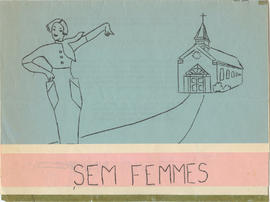
The Seminette Club (1954-1970) was for the wives, and intended wives, of students at the Evangelical Lutheran Seminary of Canada, and Waterloo College (now Wilfrid Laurier University) in Waterloo, Ontario. The purpose of the club was fellowship, study, and discussion in preparation for the role of a pastor's wife.
Helen Sanderson Sewell (1905-2001) was a Toronto artist and teacher. She attended the Ontario College of Art, graduating in 1928 with the Governor General’s Gold Medal. After graduation, she taught for six years with Arthur Lismer at the Art Gallery of Ontario and in Barrie, London, and her Toronto studio. She traveled to northern Ontario to paint with members of the Group of Seven. In 1934 she married William Sewell and interrupted her career to raise four children, including former Toronto mayor John Sewell. She resumed painting when her children were in high school, specializing in portraiture, and was active in the Toronto Heliconian Club.
Goldwin Smith (1823-1910) was a prominent journalist, academic and liberal reformer who spent the latter part of his life in Toronto. Born in Reading, England, he was educated at Eton College and Oxford University, and was the Regius Professor of History at Oxford from 1858 to 1866. Smith began to publish widely on history and political reform. He moved to the United States in 1868, and taught briefly at Cornell University, to which he retained a connection for the rest of his life. He moved to Toronto in 1871, and married Harriet Elizabeth Mann (née Dixon) the widow of William Henry Boulton, in 1875. Smith thus became master of the Grange house and estate in central Toronto, and became a pillar of Toronto society. His journalistic career included a brief employment at the Globe, after which he joined independent publishing ventures including the Canadian Monthly and National Review and the Evening Telegram. He then published his own journal, the Bystander, sporadically between 1879 and 1890. Smith also published widely in other local and international news journals. He took part in important civic and educational reform initiatives, including serving on the new board of the University of Toronto. The Grange remained his wife's property and was willed by her to the city of Toronto to serve as a public art gallery, later becoming the first home of the Art Gallery of Ontario.
Michael James Aleck Snow (1929- ) is a Canadian painter, sculptor, filmmaker, photographer and musician. He was born in Toronto and educated at Upper Canada College and subsequently at the Ontario College of Art (1948-1952). After travels in Europe (1953-54) he worked for Graphic Films in Toronto (1955-56), producing his first independent film, A-Z. His first solo exhibition as a painter was at the Greenwich Gallery in Toronto in 1956. Between 1961 and 1967, mostly while living in New York, Snow produced work in the Pop-art mode based on the silhouette of a young woman, entitled Walking Woman, probably his most widely recognized creation. A series of 11 stainless steel sculptures of the image was created for the Ontario pavilion at Expo 67 and is now in the collection of the Art Gallery of Ontario. After moving to New York in 1964, he made films regarded as Minimalist, such as New York Ear and Eye Control (1964) and Wavelength (1966-67). Returning to Toronto in 1972, Snow worked mainly on cinematic and photographic projects including ‘Rameau’s Nephew’ by Diderot (Thanx to Dennis Young) by Wilma Schoen. His work is concerned with the nature of media themselves, with perception and with the interrelation of language, sound and meaning. Snow has been the subject of exhibitions and retrospectives in Toronto, Vancouver and Paris.